A dog's teeth consist of 42 molars and teeth. 4 canines, 12 incisors, 10 large molars and 16 small molars.
The canines are the most important of the teeth.
Good dental care is very important for your dog.
Poor teeth and unhealthy gums can cause many problems.
Animals in the wild actually rarely have dental problems.
This is probably partly because their food keeps their teeth clean on a daily basis.
Unfortunately, our pets generally do not receive tooth-friendly food, which can cause plaque to build up on the teeth.
What can go wrong in the dog's mouth and how can we prevent these problems as best as possible?
Plaque buildup on the teeth is also called dental plaque.
Dental plaque is a light-colored fairly soft layer on the surface of the teeth, consisting of bacteria, bacterial metabolic products, saliva components, food debris and water.
Dental plaque develops mainly along the edges of the gums and in places where the self-cleaning mechanisms in the mouth function less well, such as rough surfaces, the space between the gum and the tooth or molar, places where the teeth or molars are too close together or in places where the teeth or molars do not fit together properly.
The self-cleaning mechanism of teeth and molars is determined by the flow of saliva, the movements of the lips, cheeks and tongue and by certain behavior after meals.
In many dogs we see that they clean their snout with their paws after eating or, for example, rub the side of their snout on the ground or along a bench or chair.
This is in fact a kind of "teeth cleaning". If the dental plaque is not removed sufficiently, the number of bacteria in it will increase and more and more "harmful" bacteria will form. These bacteria produce substances that trigger an inflammatory response of the gums.
The inflammatory process of the gums is an increasingly progressive process that can ultimately even lead to teeth and molars becoming loose. First the gum will swell and turn red, it will bleed easily when touched. Subsequently, the inflammation can spread to the deeper tissues: space forms between the tooth or molar and the gum (=pocket). Food debris and bacteria accumulate in these pockets, further aggravating the inflammatory process. The fibers that hold the tooth or molar in place become involved in the inflammatory process and break down.
A real abscess can even form in this pocket. Eventually more and more of the tissue surrounding the tooth or molar (=periodontium) is affected by the inflammatory process. This is also called periodontitis, that is, an inflammation of the supporting tissues around the teeth. The gum recedes causing the tooth neck and root to become partially exposed. In the worst case, bone loss of the tooth socket and/or a tooth socket abscess can even occur.
Brushing is of great importance for healthy teeth in dogs......
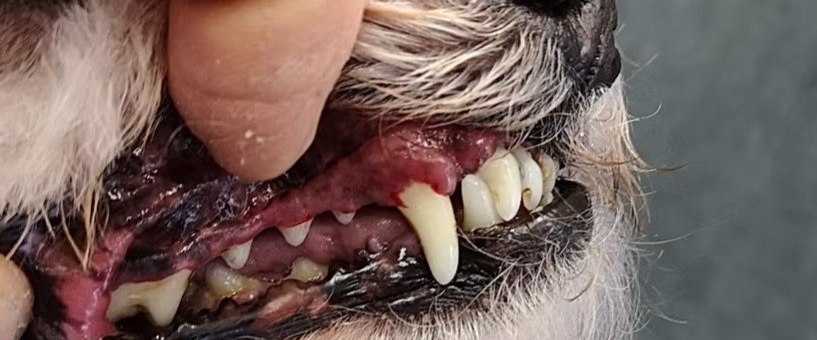
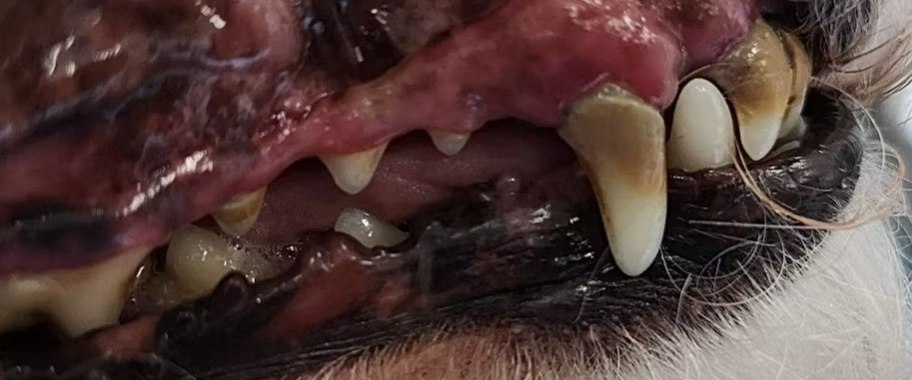
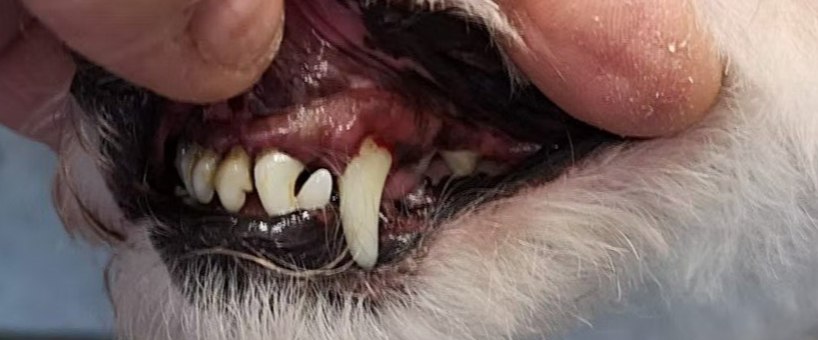
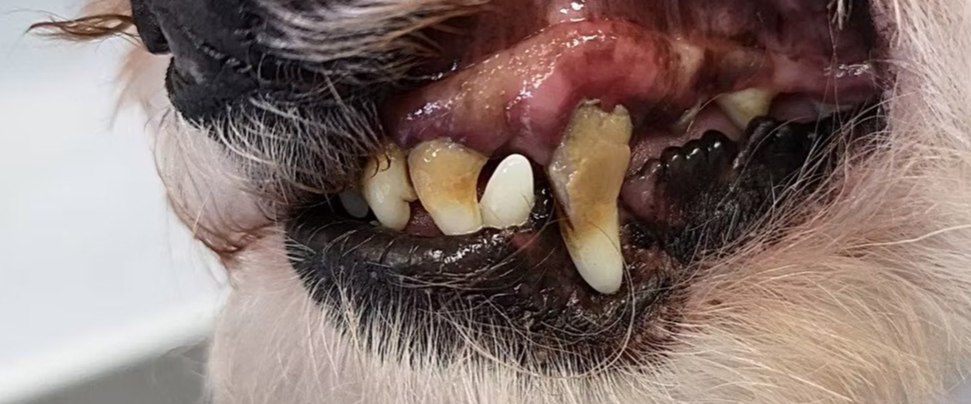
In the photos below you can see the teeth of a dog that we have treated in our grooming salon. We always check the teeth and advise you to visit a veterinarian if necessary. If possible, and if the dog allows it, we can remove tartar. Please note the dog must be comfortable with it because we do not use anesthesia and/or other sedatives. Tartar removal is not painful but the dog may find it unpleasant. In that case, we will refer you to the veterinarian.
This treatment and/or advice is included with a complete treatment in our grooming salon.
Separate teeth cleaning treatments are not available.